Export Declaration Filing
Electronic submission of export declarations to Japan Customs through the NACCS system, including the Export Permit Application and supporting commercial documentation.

Licensed Japanese customs brokerage for import and export of any cargo category. We prepare and file declarations through NACCS, classify cargo with the correct HS codes, calculate duties, and coordinate clearance — typically within 24 hours of complete documentation. Vehicles, general goods, machinery, parts — any product, both directions.
Customs clearance is the formal process of declaring goods to Japan Customs at the point of export or entry. Whether you are exporting used vehicles, general merchandise, machinery, auto parts, or any other product category — M3LOGI handles the declaration, classification, and coordination required to move your cargo across the border without delay.
M3LOGI is a licensed Japanese customs broker (通関業者). We prepare and file export declarations through NACCS, classify cargo with the correct HS codes, and coordinate with Japan Customs through to permit issuance. For import shipments arriving into Japan, we handle the corresponding inbound declaration and duty calculation.
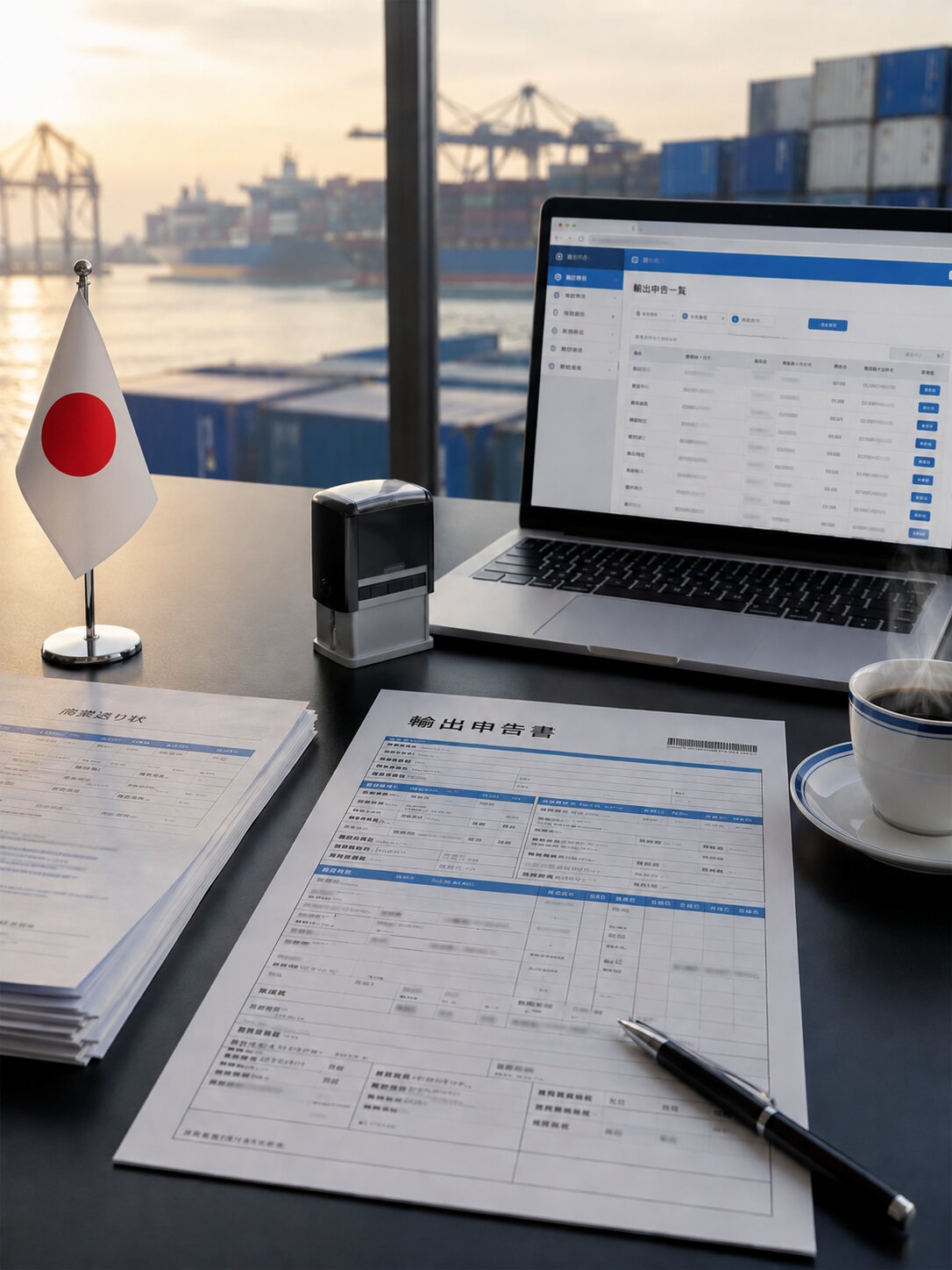
Four core services covering the customs lifecycle for any cargo category — import or export, from Japan or into Japan.
Electronic submission of export declarations to Japan Customs through the NACCS system, including the Export Permit Application and supporting commercial documentation.
Accurate Harmonized System code identification for every vehicle and accompanying item. Correct classification ensures duty calculations are right and prevents destination-side delays.
Review of commercial invoices, packing lists, vehicle titles, and supporting paperwork before declaration filing — catching inconsistencies that cause clearance delays.
Itemized calculation of applicable export duties, port handling charges, brokerage fees, and taxes — presented as separate line items on every quotation.
Four stages from document review to cargo release — applicable to any cargo category, import or export. Most clearances complete within 24 hours of complete documentation submission.
Commercial invoice, B/L, vehicle title, and supporting paperwork checked for completeness and consistency.
Cargo classified with the correct HS codes for accurate duty calculation and destination compliance.
Export declaration submitted electronically to Japan Customs through the NACCS system.
Once approved by customs, the export permit is issued and cargo is released for vessel loading.
A registered Japanese customs broker (通関業者) filing declarations directly with Japan Customs through NACCS.
Most declarations complete within 24 hours when documentation is in order — supporting tighter vessel loading windows and reducing demurrage exposure.
Vehicles, general merchandise, auto parts, machinery — we clear any product category for both import and export. No restriction on cargo type.
One specialist managing the file from declaration through to permit — no handoffs between brokers, agents, or call centers.
The typical customs document set for export or import shipments from Japan. Each document below is prepared, reviewed, or filed by the M3LOGI customs team as part of the brokerage service. Missing or inconsistent documents are the most common cause of clearance delays.
The official electronic declaration filed with Japan Customs through the NACCS system. Lists every vehicle or item being exported, declared value, destination, and HS classification. Required for every shipment leaving Japan.
Issued by the seller to the buyer. Declares cargo description, sale value, and Incoterm. The customs value declared here directly affects destination duty calculation, so accuracy is critical.
Detailed inventory of what is being shipped — descriptions, quantities, weights, and dimensions. For vehicle shipments, includes VINs and accessories. Required for container shipments and reviewed by destination customs.
Contract of carriage between shipper and carrier. Submitted as part of the export declaration package. B/L preparation is coordinated with the carrier to ensure consistency with the customs declaration.
Declares where the vehicle was manufactured. Affects destination duty rates and free-trade-agreement eligibility — vehicles manufactured in Japan may qualify for preferential treatment in some markets.
Customs clearance involves multiple line items rather than a single fee. The components below outline what a complete quotation typically includes for any cargo type, helping shippers compare quotes on equivalent terms.
The fee for our work — preparing documents, filing the declaration, classifying HS codes, and coordinating with customs. Charged per declaration, regardless of cargo value.
Japan generally does not impose export duties on vehicles or general cargo. Some restricted categories may incur fees — these are flagged at quotation.
Charged by the destination country and paid by the buyer (importer of record). Calculated as a percentage of declared value (ad valorem) — varies by country, vehicle category, and any free-trade-agreement eligibility. M3LOGI does not collect destination duties; accurate documentation is provided for the buyer's local broker to calculate them correctly.
Most countries apply a value-added tax or sales tax on imported goods, calculated on cargo value plus freight, insurance, and import duty combined. Effective tax rates on imported vehicles can sometimes exceed domestic rates.
Administrative charges for issuing certificates, processing the declaration through NACCS, and managing physical document handling. Typically a fixed fee per shipment.
Some destinations require pre-export inspection (PEI) by approved agencies — JEVIC, JAAI, EAA, QISJ. The inspection fee varies by agency and destination. See the Vehicle Inspection page for current rates.
Most export declarations are processed within 24 hours when documentation is complete and accurate. Issues with documents (missing signatures, mismatched values, classification errors) can extend the process by several days.
Charges are typically split: the shipper pays the export customs fee at origin, and the receiver pays the import customs fee at destination. The exact responsibility depends on the agreed Incoterm. Under DDP (Delivered Duty Paid) the seller covers everything; under EXW or FOB the buyer covers most.
A licensed professional or company contracted to prepare and submit customs declarations on behalf of an importer or exporter. The broker ensures the declaration is correct, duties are calculated accurately, and the goods can move smoothly through customs without disruption.
The official document filed with customs authorities listing every detail of goods crossing a border — what they are, their value, origin, and applicable duties. In Japan and most countries, declarations are submitted electronically (Japan uses the NACCS system).
The Harmonized System code is an internationally standardized classification for traded goods. Even small differences in classification can change duty rates significantly, so accurate identification is important. Used cars typically fall under HS 8703.
Generally no. Japan does not impose export duties on most goods including used vehicles, general merchandise, auto parts, and machinery. Some restricted or controlled categories may have additional requirements — these are identified and flagged at the quotation stage before any filing begins.
If customs requires additional information or finds an issue, the cargo is held until the declaration meets their requirements. M3LOGI responds directly to customs inquiries, corrects the filing, and resubmits. Most issues clear within one to two business days.
Yes. We handle both export customs at origin in Japan and import customs for goods arriving into Japan. For destination import clearance in other countries, we coordinate with our partner brokers or with the customer's appointed local broker, providing the full document set required for prompt clearance on arrival.